What Is an Enamel Spraying Line? Wet and Dry Enameling Compared
In the realm of advanced industrial surface finishing, the enamel spraying line stands as a pinnacle of engineering, bridging the gap between aesthetic brilliance and extreme durability. Porcelain enamel, a glass-like inorganic coating fused to a metal substrate at high temperatures, requires a sophisticated and controlled environment for application. Whether manufacturing high-end kitchen appliances, architectural cladding, or industrial water heaters, the selection of the right spraying technology is critical for product longevity and performance.
Modern manufacturing facilities are increasingly moving away from manual application toward fully automated systems. This evolution is driven by the need for consistency, material efficiency, and environmental compliance. An enamel spraying line integrates several complex stages, including surface preparation, precise coating application, and high-temperature fusion, all synchronized by intelligent control systems. Understanding the nuances between different enameling methods is essential for manufacturers aiming to optimize their production output and maintain a competitive edge in global markets.
The Core Technology of Enamel Spraying Lines
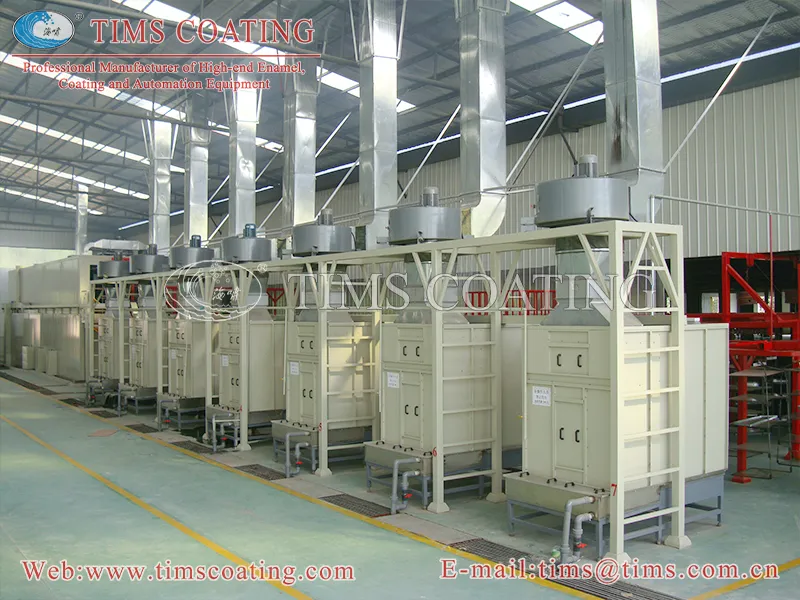
An integrated enamel spraying line is much more than a simple conveyor and spray booth. It is a highly specialized production environment designed to handle the unique properties of enamel frit. Unlike traditional liquid paint or standard powder coatings, enamel consists of finely ground glass particles and pigments. To ensure these materials bond permanently to steel or cast iron, the spraying line must maintain rigorous control over atmospheric conditions, powder charging, or slurry viscosity.
The process begins with meticulous surface preparation, often involving grit blasting or chemical pickling to achieve a surface roughness that facilitates mechanical and chemical bonding. Within the booth, electrostatic guns or high-pressure sprayers apply the enamel layer. The automation involved here is remarkable; AI-powered thickness control sensors monitor the coating in real-time, ensuring that every square millimeter receives a uniform thickness ranging from 0.2mm to 1.5mm. This precision is vital because inconsistent enamel thickness can lead to chipping or internal stresses during the firing phase, which occurs at temperatures exceeding 850 degrees Celsius.
Furthermore, modern lines incorporate real-time defect detection through hyperspectral imaging. This allows for the immediate identification of flaws such as uneven coverage or contaminants before the product enters the furnace. By filtering out defective items early, manufacturers significantly reduce energy waste and material loss. The modular design of these systems also allows for rapid adjustments, enabling the line to switch between different product geometries, such as flat architectural panels or complex 3D shapes like oven cavities, without significant downtime.
Comparing Dry and Wet Enameling Processes
Choosing between a dry electrostatic process and a wet slurry process is one of the most critical decisions in designing an enamel spraying line. The dry process utilizes electrostatic forces to attract dry enamel powder to the workpiece. This method is highly favored in modern appliance manufacturing because it offers up to 95% material utilization. Since the powder that does not stick to the part can be reclaimed and recycled, it is an exceptionally efficient and eco-friendly solution for high-volume production.
The wet enameling process, conversely, involves suspending the frit in a liquid medium to create a slurry. This slurry is applied via spraying, dipping, or flow-coating. While the material recovery rate is generally lower than that of the dry process, wet enameling remains indispensable for certain applications. For instance, complex internal geometries or very large industrial components often benefit from the "wrapping" effect of liquid application. Wet systems are also preferred when specific aesthetic textures or multi-colored gradients are required, as the liquid medium allows for more intricate pigment blending.
In terms of infrastructure, a dry enamel spraying line typically requires a controlled environment with specific humidity and temperature settings to ensure the electrostatic charge remains stable. Wet lines, while less sensitive to environmental humidity during application, require intensive drying zones to remove moisture from the coating before it enters the firing furnace. Both methods have been optimized by leading manufacturers like TIMS to integrate seamlessly into automated workflows, allowing for "Two-Coat-One-Fire" (2C1F) processes that significantly reduce energy consumption and production time.
High-Temperature Curing and Energy Efficiency
The heart of any enamel production facility is the furnace. Once the coating is applied on the enamel spraying line, the workpiece must be heated to between 800 and 900 degrees Celsius. This is the moment of vitrification, where the glass frit melts and fuses with the metal surface to create a chemical bond that is virtually indestructible. Modern furnaces use gas-fired radiant tubes or electric heating elements to maintain ±5 degrees Celsius uniformity across the entire heating chamber.
Energy conservation is a primary focus for modern industrial operators. Advanced systems now feature IoT-enabled energy recovery modules. These modules capture the massive amount of waste heat generated during the cooling phase and redirect it back to the pre-treatment tanks or the drying ovens. This closed-loop approach can reduce natural gas consumption by up to 20%, offering both environmental benefits and substantial cost savings. TIMS has pioneered several patented technologies in this area, ensuring that the firing process is as efficient as it is effective.
Uniformity in heat distribution is not just about saving energy; it is a quality control requirement. If one side of a steel plate is heated faster than the other, the resulting thermal shock can cause warping or cracking in the glass layer. Therefore, the conveyor systems within the enamel spraying line are engineered for smooth, vibration-free movement, ensuring that the parts pass through the thermal zones with absolute precision. This level of control ensures that the finished products meet international standards such as ISO 12944 and EN 10209.
Industry Applications and Performance Standards
The versatility of the enamel spraying line allows it to serve a diverse range of industries. In the domestic appliance sector, it is used to coat oven interiors, microwave cavities, and dishwasher panels. The resulting surface is not only resistant to high temperatures but also acid-resistant and incredibly easy to clean, making it the gold standard for food-contact surfaces. Furthermore, the enamel formulation meets strict FDA standards, ensuring safety and hygiene for consumers worldwide.
Architectural cladding is another booming sector for enameling technology. Large-scale steel panels used in subway stations, tunnels, and premium building facades are coated using these lines to protect them from UV fading, graffiti, and extreme weather. Because the enamel is essentially a layer of glass, it does not degrade over decades of exposure to the elements. This makes it a sustainable choice for urban infrastructure, reducing the need for frequent maintenance or replacement.
Industrial equipment, such as water heater tanks and chemical storage vessels, also relies on high-performance enameling. In these applications, the coating must withstand constant exposure to hot water and corrosive chemicals. A specialized enamel spraying line for water heaters ensures that the internal surface is fully encapsulated, preventing rust and extending the tank's life from a few years to over a decade. By utilizing advanced robotic arms, manufacturers can ensure even coverage in the most difficult-to-reach corners of these cylindrical tanks.
The TIMS Advantage in Enamel Technology
As a leading manufacturer and innovator, TIMS provides comprehensive solutions for those looking to invest in a high-efficiency enamel spraying line. Our strength lies in our ability to deliver turnkey systems that are custom-tailored to the specific dimensions and throughput requirements of our clients. From the initial design phase to global installation and commissioning, TIMS ensures that every component is optimized for performance and reliability.
Our enamel coating lines for steel plates utilize industry-first flexible production technology. A single TIMS line can simultaneously process multiple product types and dozens of different models, reducing initial investment costs by over 50%. We integrate advanced features like AI-powered thickness control and proprietary energy recovery systems (Patent No. CN ZL 202423315073.8) to help our partners achieve greener, more profitable production.
Beyond equipment manufacturing, TIMS offers lifelong technical support and a full range of services. Our systems, including the automated production line equipment, are certified by CE, ISO9001, and SGS. Whether you are upgrading an existing facility or building a new factory from the ground up, TIMS provides the expertise and advanced technology needed to succeed in the demanding field of surface coating.
Conclusion
The enamel spraying line is an essential asset for any manufacturer dedicated to producing high-quality, durable, and aesthetic metal products. By choosing the right combination of wet or dry application and integrating advanced automation, businesses can achieve unparalleled efficiency. TIMS remains your trusted partner in this journey, offering world-class technology and customized solutions.
Frequently Asked Questions
Q1: What are the primary benefits of an automated enamel spraying line?
Automated lines provide superior consistency, reduced labor costs, and significantly higher material utilization compared to manual processes. They also integrate safety features and environmental controls to meet modern industrial standards.
Q2: Can an enamel spraying line handle different materials like cast iron and carbon steel?
Yes, modern lines are highly adaptable. By adjusting the pre-treatment phase and the firing temperature, the same basic system can be used to coat various substrates, including low-carbon steel, cast iron, and even stainless steel.
Q3: How does the dry process in an enamel spraying line improve efficiency?
The dry electrostatic process allows for nearly 95% material recovery. The powder that does not adhere to the workpiece is collected by a filtration system and returned to the supply tank, minimizing waste and environmental impact.
Q4: Is the finish from a wet enamel spraying line better for complex shapes?
Wet enameling often provides better coverage for extremely intricate internal geometries because the liquid slurry can flow into areas where electrostatic powder may have difficulty penetrating. It is ideal for cookware and small industrial parts.
Q5: What maintenance is required for a professional enamel spraying line?
Regular maintenance includes cleaning the spray nozzles, inspecting the conveyor chain for wear, and calibrating the furnace temperature sensors. TIMS provides lifelong technical support and spare parts to ensure long-term operational stability.