How Does an Electrophoretic Coating Production Line Improve Coating Quality?
In the modern industrial landscape, achieving a flawless, durable finish on metal components is no longer just an aesthetic requirement but a functional necessity. Manufacturers across the automotive, home appliance, and heavy machinery sectors are increasingly turning to the electrophoretic coating production line to solve complex finishing challenges. This advanced technology, often referred to as E-coating, utilizes electrical currents to deposit paint onto a substrate, ensuring a level of precision and uniformity that traditional spray methods simply cannot match. By integrating physics, chemistry, and high-level automation, this system provides a comprehensive solution for protecting intricate geometries against the harshest environmental conditions.
The transition toward more sustainable and efficient manufacturing processes has further solidified the importance of the electrophoretic coating production line. As global standards for corrosion resistance and environmental impact become more stringent, companies like TIMS are leading the way by providing state-of-the-art systems that minimize waste while maximizing output quality. In this guide, we will explore the technical mechanisms, strategic advantages, and industrial applications that make this production line an indispensable asset for high-volume manufacturing.
The Core Mechanism of Electrophoretic Deposition
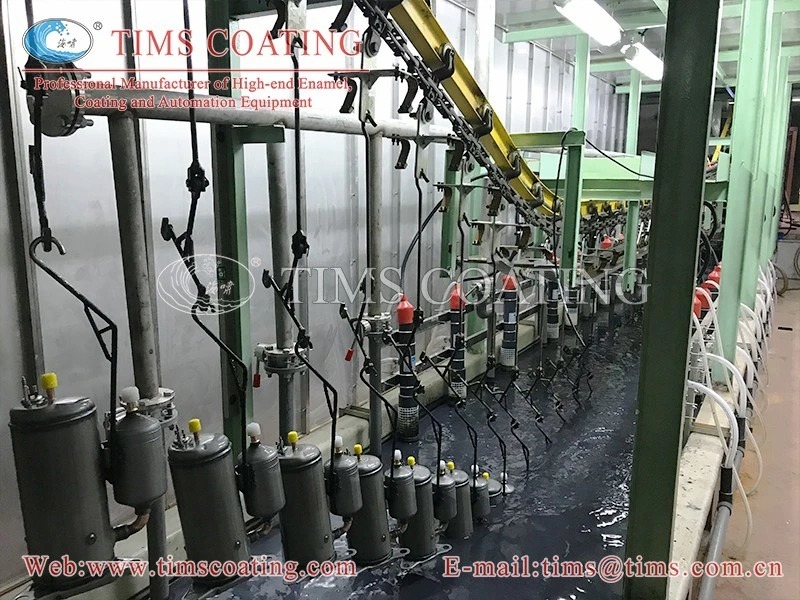
Understanding how an electrophoretic coating production line improves quality starts with the science of electrochemistry. Unlike traditional liquid spraying where the paint is mechanically atomized and pushed toward the part, electrophoresis involves immersing the workpiece into a charged bath of water-based paint. The workpiece acts as one electrode, while the tank or separate electrodes act as the opposite. When a direct current is applied, the paint particles are attracted to the surface of the metal with mathematical precision. This process continues until the deposited layer reaches a specific thickness that provides electrical insulation, naturally stopping the process.
This "self-limiting" characteristic is what allows the electrophoretic coating production line to achieve such high coating quality. It ensures that every square millimeter of the surface, including sharp edges, deep recesses, and interior cavities of complex welded structures, receives the exact same thickness of paint. In sectors like automotive manufacturing, where a vehicle chassis has countless hidden corners, this level of coverage is vital for preventing rust from the inside out. By removing the "human element" and the limitations of line-of-sight spraying, the system delivers a level of consistency that is statistically superior to manual or robotic spray lines.
Critical Stages in a Professional Production Flow
A high-performance electrophoretic coating production line is not just about the dipping tank; it is a multi-stage ecosystem designed for perfection. The process typically begins with an intensive pre-treatment phase. At TIMS, we emphasize the importance of alkaline degreasing, acid pickling, and phosphating. These steps remove oils, oxides, and contaminants, creating a microscopic roughness that facilitates superior paint adhesion. Without a properly executed pre-treatment, even the most advanced electrophoresis bath would fail to provide the long-term durability required for industrial applications.
Following the pre-treatment, the workpiece enters the electrophoresis stage where the actual coating occurs. Advanced systems today utilize real-time monitoring of bath chemistry, temperature, and voltage to ensure stable deposition. After the dip, the part moves through a series of ultra-filtration (UF) rinses. This is a critical efficiency feature of the electrophoretic coating production line, as it allows the excess, non-deposited paint to be washed off and returned to the main tank, resulting in material utilization rates that often exceed 95%. Finally, the parts enter a curing oven, typically operating between 180°C to 200°C for standard E-coat or even higher for specialized enamel-hybrid systems, to cross-link the resin and form a dense, protective film.
Quantifiable Advantages for Modern Manufacturing
Components processed on an electrophoretic coating production line regularly exceed 1000-hour salt spray tests, making them ideal for automotive and outdoor industrial equipment.
The closed-loop recycling system ensures that almost every drop of paint is utilized, significantly reducing production costs compared to traditional liquid spray systems.
With advanced conveyor systems, these lines can process 600-800㎡ per hour, providing the scalability needed for massive industrial batches.
Water-based coatings used in electrophoresis significantly reduce VOC emissions and hazardous waste, aligning with global green manufacturing standards.
TIMS: Your Partner in Advanced Coating Technology
As a global leader in the industry, TIMS provides comprehensive finishing solutions tailored to the specific needs of our clients. Our expertise extends from manual setups to fully automated electrophoretic coating production line systems. We pride ourselves on our advanced electrostatic technology and intelligent control systems that ensure consistent coating thickness and minimal waste. Our systems are widely recognized in the automotive, appliance, and furniture sectors for their reliability and performance.
TIMS’s strength lies in our ability to innovate. For instance, our compressor electrophoresis lines are engineered to exceed 1000-hour salt spray tests, ensuring long-term durability for high-stress components. We also offer specialized powder coating production line equipment and enamel production line solutions, providing a turnkey approach for any manufacturing environment. By choosing TIMS, you are investing in a system that integrates IoT-enabled energy recovery and AI-powered quality detection to keep your production at the forefront of efficiency.
Frequently Asked Questions
Q1: How does an electrophoretic coating production line ensure uniform thickness?
The uniform thickness is achieved through the self-limiting nature of the electrochemical process. As the paint layer builds up, it acts as an electrical insulator. Once the desired thickness is reached based on the applied voltage, the current flow stops, preventing further deposition and ensuring an even finish across the entire part.
Q2: What materials can be processed on an electrophoretic coating production line?
Most conductive materials are suitable for electrophoresis. This includes carbon steel, galvanized steel, aluminum, cast iron, and even some specialized conductive plastics. It is particularly effective for complex metal assemblies like car frames or appliance housings.
Q3: Is an electrophoretic coating production line more energy-efficient than powder coating?
While both have benefits, the electrophoretic line often has a higher material utilization rate (up to 95-98%) and can be operated at lower voltages. Furthermore, modern TIMS systems include waste heat recovery in the curing ovens, significantly reducing overall natural gas and electricity consumption.
Q4: How long does the pre-treatment take in an electrophoretic coating production line?
The pre-treatment duration depends on the contamination level of the parts but typically involves 7 to 11 stages (including cleaning, rinsing, and phosphating), each lasting between 1 to 3 minutes in a continuous conveyorized system.
Q5: Can an electrophoretic coating production line handle different colors quickly?
Electrophoresis is generally best suited for high-volume, single-color applications (like black primers). However, with modular tank designs or multiple dip stations, color changes are possible, though they are not as instantaneous as in a liquid spray or quick-change powder booth.
Ready to Elevate Your Production Quality?
An investment in a modern electrophoretic coating production line is an investment in the longevity and reputation of your products. With TIMS’s advanced engineering and turnkey solutions, you can achieve world-class finishing standards with reduced operational costs.
Contact TIMS for a Custom Configuration